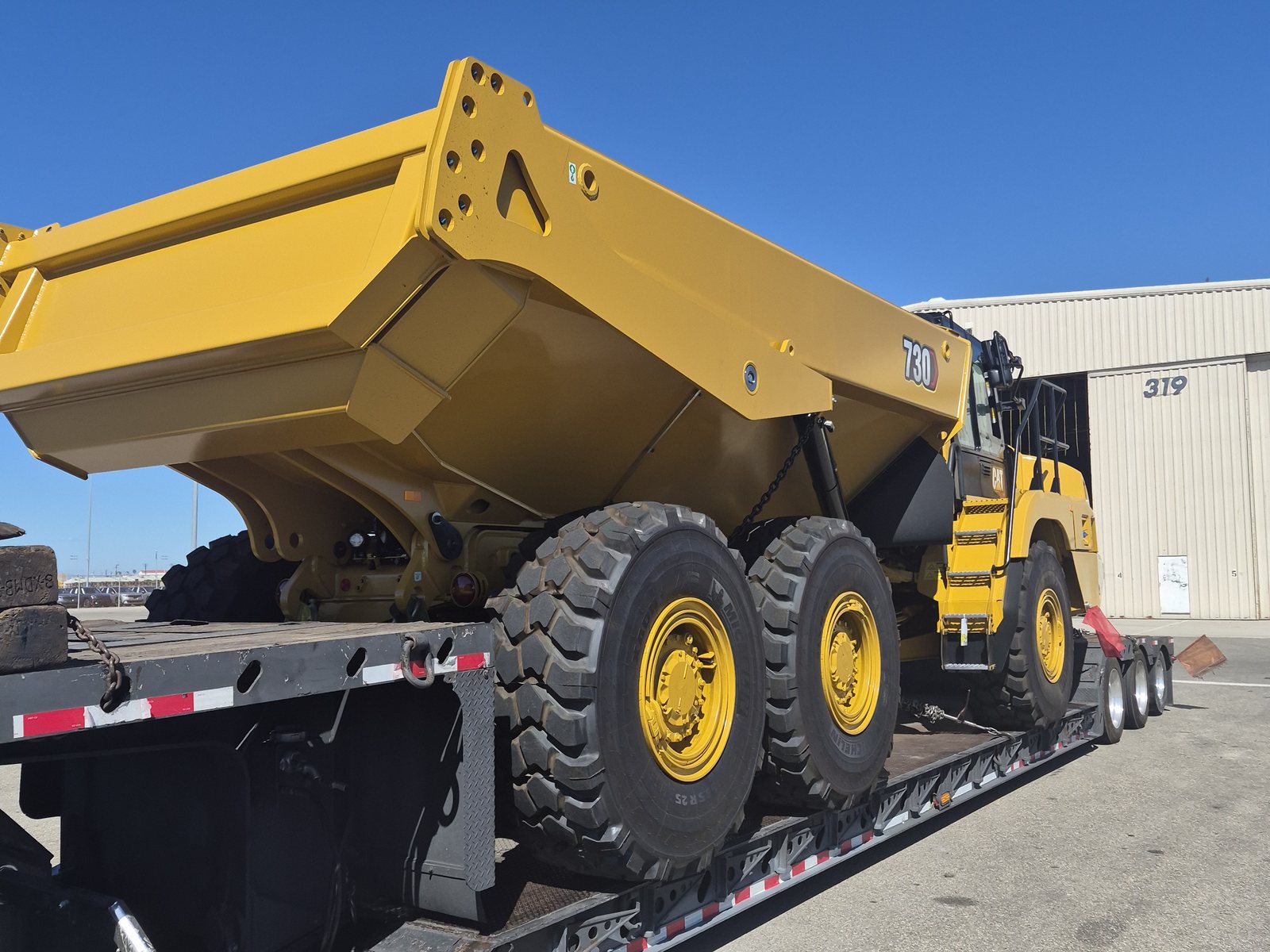
A load becomes oversize or overweight the moment it is bigger or heavier than a truck can legally carry without a permit. From there, the trailer, the route, the days it can travel, and the price all change. Here is what to know before you ask for a quote.
When is a load oversize or overweight?
Each state sets its own limits, but most of them start from the same numbers:
- Width: 8 feet 6 inches.
- Height: 13 feet 6 inches from the road to the top of the load in most states. Many western states allow 14 feet.
- Length: what fits on a 48 or 53 foot trailer. How much overhang is allowed past the trailer differs by state.
- Weight: 80,000 pounds gross, counting the truck, the trailer, and the freight, with a limit on each axle group as well. In practice that leaves room for about 45,000 to 48,000 pounds of freight.
Go past any one of those and the load needs a permit in each state on the route where it is over that state’s limit.
The terms overlap. Oversize and over-dimensional mean the same thing: too wide, too tall, or too long. Overweight is the weight side. Heavy haul is the everyday name for freight that is one or both. A load can be oversize without being heavy, like a wide, empty tank. It can also be overweight without being oversize, like a dense piece of machinery that fits the deck with room to spare.
Height depends on the trailer as much as the freight
Height is measured from the road, so the height of the deck counts against you. A piece that is over height on a flatbed can be legal on a lower trailer.
- Flatbed: freight up to about 8 feet 6 inches tall.
- Step deck: freight up to about 10 feet tall.
- Double drop, RGN, or lowboy: freight up to about 11 feet 6 inches to 12 feet tall, depending on the trailer.
Picking the right trailer can be the difference between a permit load and a legal one. An RGN has one more advantage: the front detaches, so a machine on wheels or tracks drives on at ground level.
Permits are for loads that cannot be broken down
States write oversize and overweight permits for non-divisible loads, meaning a single piece that cannot reasonably be taken apart. Two crates loaded side by side that make the load 10 feet wide will generally not get a permit. The answer there is a second truck.
It works the other way too. Taking a bucket, a blade, or a counterweight off a machine can bring it under a limit, or drop it into a cheaper permit. Sometimes two smaller loads cost less than one big one. It is worth asking before you ship.
What changes once a permit is involved
- Permits, state by state. Every state on the route issues its own permit for that load on that route. Routine permits are usually quick. Very large or very heavy loads, often called superloads, can take much longer and may need a route survey or a bridge review first.
- Escorts. Past a certain size, a load has to travel with one or more escort vehicles, also called pilot cars. Every state draws that line in its own place. Width is the most common trigger, and many states start at around 12 feet wide. A tall load may need a high pole car, an escort that runs ahead with a pole set to the load’s height to check clearances.
- Travel times. Many states only let oversize loads move in daylight, and limit travel on weekends and holidays. Some cities add curfews around rush hour. A run a regular truck makes in one day can take two.
- The route. The permit names the roads. It may not be the shortest way, because low bridges, weight limits, and construction all have to be avoided.
What goes into the price
A heavy haul rate is more than miles. It includes the truck and trailer, a permit for each state, escorts where they are required, the extra days that travel limits add, and anything needed at either end, such as tarping or detention while the piece is loaded.
Ask for one all-in number. A low per-mile rate that leaves out permits and escorts is not the real price. We quote permits, escorts, and linehaul together, so what you approve is what you are invoiced.
What to send for a quote
- What the freight is. For equipment, the make and model.
- Length, width, and height at the largest points, and the weight.
- Whether it rolls or drives, and whether it runs.
- Whether anything can come off to make it smaller or lighter.
- The pickup and delivery addresses, and how it will be loaded and unloaded at each end.
- When it is ready and when it has to be there.
Measure the piece itself where you can. A spec sheet does not include the attachment someone added later, and a few inches can change the trailer, the permit, and the price. When the dimensions are wrong, the truck that shows up may not be able to legally take the load.
Or send it to Fello
You do not have to sort this out yourself. Send over the dimensions, weight, origin, and destination, and we’ll get you pricing and availability quickly. We arrange heavy haul and oversize loads on step decks, double drops, RGNs, lowboys, multi-axle trailers, and more, with one contact start to finish. For what that looks like under pressure, read how twenty heavy haul loads were covered in three days.